New Patients23 Nov 2026
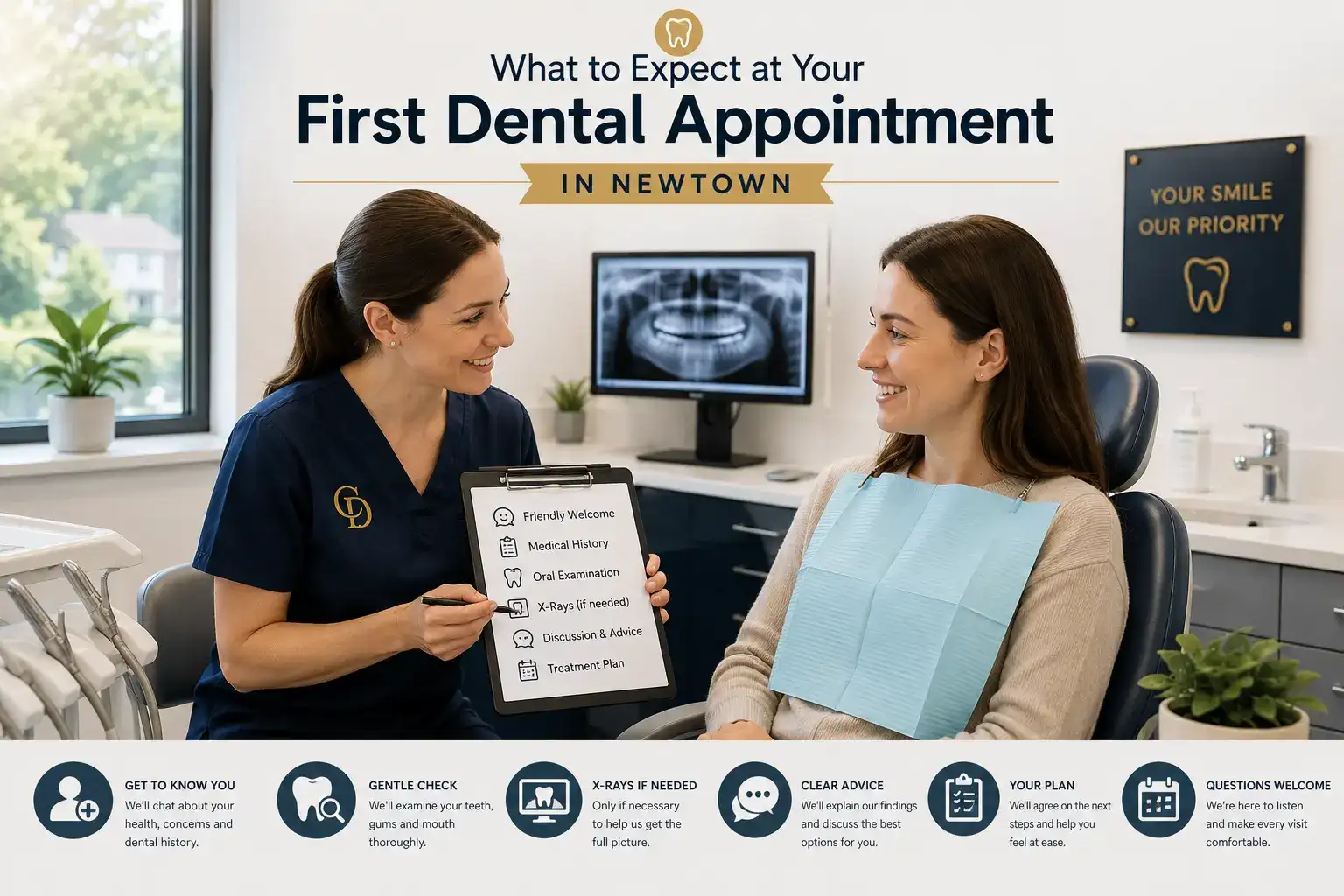
What to Expect at Your First Dental Appointment in Newtown
The six stages of a new patient dental examination, what the gum scores mean, and the written plan you should leave with.
9 min readRead More →
Oral Health
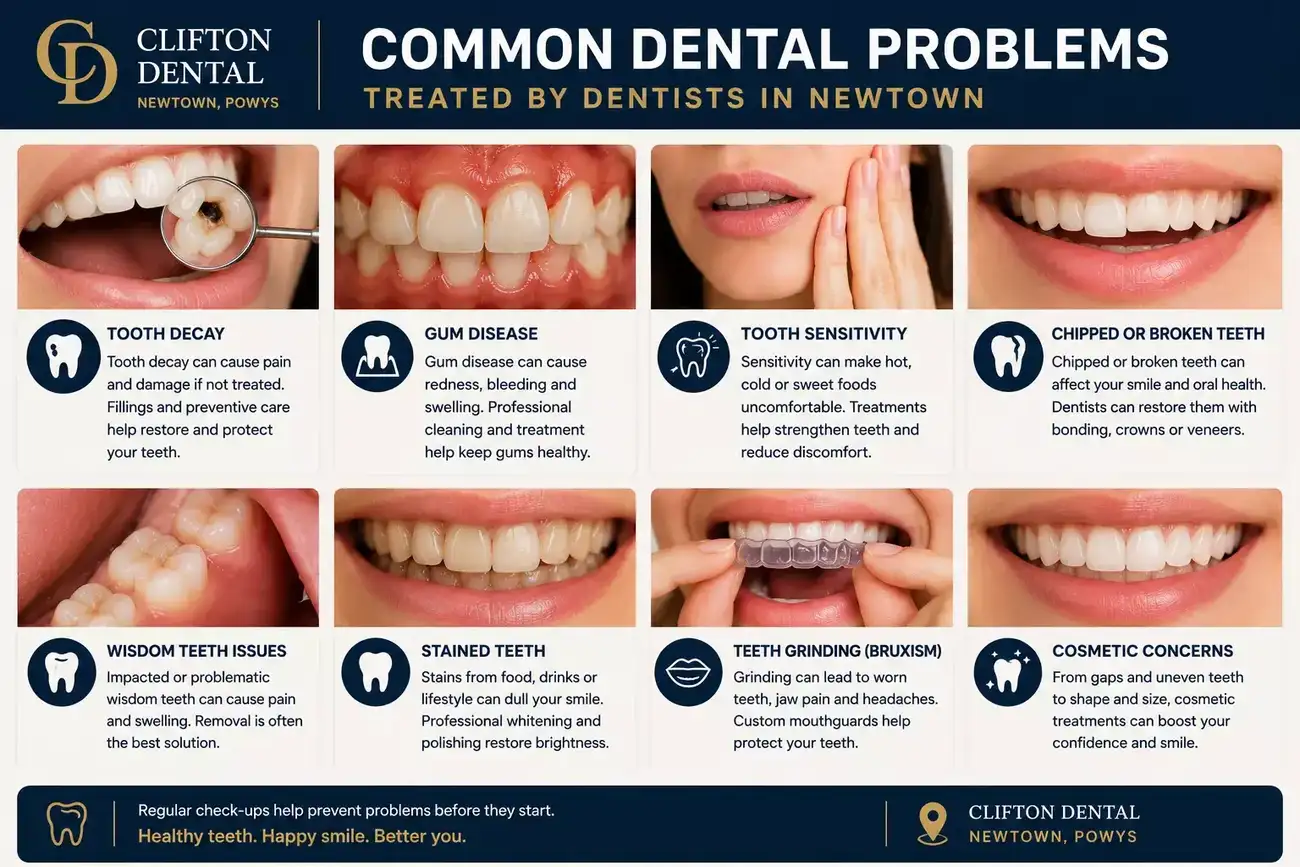
Quick answer: Most dental problems Newtown Powys practices treat fall into four groups: decay, gum disease, cracked or worn teeth, and infection. Decay in adults has risen sharply, with 41% of adults showing obvious decay in the 2023 national survey against 28% in 2009. Gum disease is the one that usually causes no pain until it is advanced. Any pain that keeps you awake, any facial swelling, and any mouth ulcer lasting more than three weeks should be seen rather than watched.
This article is not a diagnosis. It explains what different symptoms commonly point to and how urgently each one usually needs looking at. It cannot tell you what is wrong with your own mouth, because that needs an examination and often a radiograph. If you are in pain now, ring a practice rather than reading on.
Adult tooth decay in England has risen sharply and reversed earlier improvements. The Adult Oral Health Survey 2023, published on 9 December 2025 and reported by Newcastle University, found 41% of adults with natural teeth had obvious tooth decay when examined, against 28% in the 2009 national survey, taking levels back towards those last seen in the late 1990s.
Under a broader measure that includes enamel decay, nearly two thirds of adults showed signs of decay. Enamel decay is the early stage that can often be arrested rather than drilled, which is exactly why it is worth catching.
43% of adults reported that their oral health had negatively affected their daily life, up from 33% in 2009. The survey also found regular check-ups had declined and that access barriers, including being unable to find a dentist and cost, were common.
This survey covers England, not Wales. Dentistry is devolved and Welsh access arrangements differ. It is the best current clinical picture of UK adult oral health available, and the direction it shows is relevant here, but it is not a Welsh figure and should not be read as one.
Pain is the most common reason people ring about dental problems in Newtown, Powys. The useful question is not how much it hurts but how it behaves, because duration, trigger and timing tell a dentist more than intensity does.
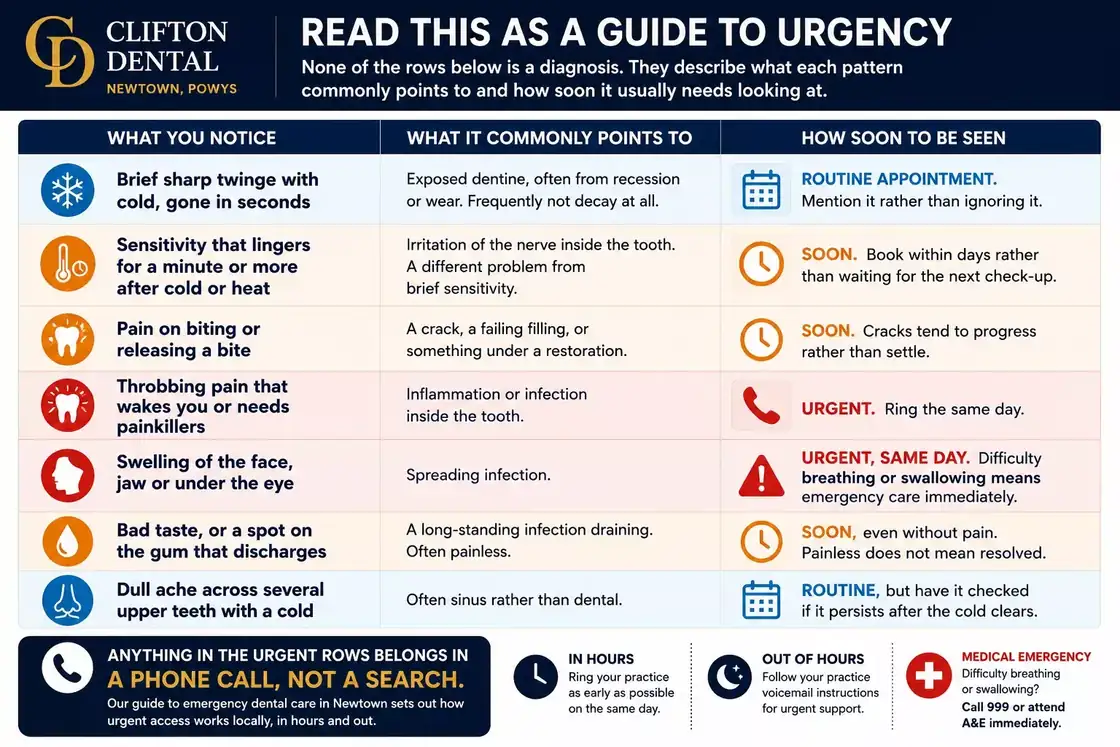
None of the rows below is a diagnosis. They describe what each pattern commonly points to and how soon it usually needs looking at.
Brief sharp twinge with cold, gone in seconds
Sensitivity that lingers for a minute or more after cold or heat
Pain on biting or releasing a bite
Throbbing pain that wakes you or needs painkillers
Swelling of the face, jaw or under the eye
Bad taste, or a spot on the gum that discharges
Dull ache across several upper teeth with a cold
Anything in the urgent rows belongs in a phone call, not a search. Our guide to emergency dental care in Newtown sets out how urgent access works locally, in hours and out.
If pain has already started. Infections inside a tooth do not resolve on their own, and painkillers treat the symptom rather than the cause. Clifton Dental Practice offers root canal treatment for teeth where the nerve is affected. Call 01686 626252 to describe the symptom and be triaged properly.
Gum disease is the most commonly missed of all the dental problems Newtown Powys dentists treat, because the early and middle stages are usually painless. People notice bleeding when brushing, decide they are brushing too hard, and brush more gently. That is the wrong response.
Healthy gums do not bleed when brushed properly. Bleeding usually indicates inflammation, and the answer is normally better cleaning at the gum margin rather than less cleaning.
At your check-up the dentist scores your gums using the Basic Periodontal Examination. British Society of Periodontology guidance divides the mouth into six sextants and scores each 0 to 4. Codes 3 and 4 can lead to more detailed charting, and radiographs should be available for those sextants.
Bone lost around a tooth does not grow back. Treatment can stop the process and keep what remains, but it cannot rebuild what has gone. That is why a score recorded before you notice anything is worth more than a symptom you eventually feel.
Day to day prevention is a separate subject, covered in oral health tips from Newtown dentists.
These three get grouped together as damage that is not decay, and they behave differently from each other. Together they account for a large share of the dental problems Newtown Powys practices treat in adults who have kept their own teeth.
Often show up as pain on releasing a bite rather than on biting down. Cracks are difficult to see on a radiograph and are frequently diagnosed from how the tooth behaves. Heavily filled back teeth are the usual candidates, and cracks tend to progress rather than settle.
Grinding and clenching flatten the biting surfaces over years, often without the person knowing. Waking with jaw tightness or headaches, or a partner mentioning grinding at night, are the usual clues. A guard protects the teeth rather than stopping the habit.
Different from wear and different from decay: the enamel dissolves chemically, from diet or from reflux. Fizzy drinks, citrus, sports drinks and frequent snacking all contribute, and the frequency matters more than the quantity. Erosion is one of the few dental problems where changing one habit genuinely changes the outcome.
Where teeth are already damaged or missing, Clifton Dental Practice offers restorative dentistry options from fillings and crowns through to replacing missing teeth.
These are the things worth booking for even when nothing hurts. Almost all of them turn out to be something ordinary, and that is the point of having them checked rather than watched.
NHS Wales publishes the red flags dentists are trained to act on, drawn from NICE guideline NG12 on suspected cancer recognition and referral. The Wales dental referrals guidance lists them as follows.
Use the three-week rule and stop there. Most mouth ulcers heal within one to two weeks, so the threshold exists precisely because ordinary ulcers clear well before it. Something lasting past three weeks is worth an appointment, not worth a night of searching.
Ask any practice you are registering with how it handles urgent referrals. At the September 2025 Healthcare Inspectorate Wales inspection of Clifton Dental Practice, inspectors recorded that referrals were made electronically and that staff would follow up any referrals considered urgent, such as suspected oral cancer, to ensure patients were given a timely appointment.
Not to alarm anyone. The soft tissue check at a routine appointment takes about two minutes and covers all of this without you having to remember a list. The list matters for the years when people do not attend, which the national survey shows are increasing.
Broadly four routes, and which one applies depends on how far the problem has gone rather than on which practice you attend. Most dental problems in Newtown, Powys resolve on one of them.
Early enamel decay
Established decay
Decay or infection reaching the nerve
Gum disease, codes 1 and 2
Gum disease, codes 3 and 4
Cracked tooth
Missing teeth
For the wider picture of keeping problems from starting, see the complete oral health guide for Newtown.
Not sure how urgent it is? Describe the symptom on the phone rather than booking the first available slot online. Say whether it wakes you, whether there is swelling, and how long it has been going on. Those three answers are what a practice triages on. Clifton Dental Practice: 01686 626252.
Decay, gum disease, cracked or worn teeth, and infection inside a tooth. The 2023 Adult Oral Health Survey found 41% of adults with natural teeth had obvious decay, up from 28% in 2009, so decay remains the most common by some distance.
Bleeding usually indicates inflammation rather than injury, and healthy gums do not bleed when brushed properly. The common response of brushing more gently tends to make it worse. Mention it at your next appointment, since gum disease is largely painless until advanced.
No. A brief twinge with cold that disappears in seconds is often exposed dentine from recession or wear. Sensitivity that lingers for a minute or more afterwards is a different problem, usually involving the nerve inside the tooth, and needs booking within days.
When it wakes you at night or needs regular painkillers, and when there is facial or jaw swelling. Both should be seen the same day. Swelling with difficulty breathing or swallowing needs emergency care immediately rather than a dental appointment.
Most heal within one to two weeks. NHS Wales guidance, drawn from NICE guideline NG12, treats an unexplained ulcer or swelling in the mouth lasting more than three weeks as a reason for assessment. The great majority turn out to be something ordinary.
The early inflammatory stage usually responds well to better cleaning and professional treatment. Once bone around the tooth has been lost, it does not grow back. Treatment can halt the process and preserve what remains, which is why early detection matters.
Not always. It depends on how far the crack extends and whether the nerve is involved. Small cracks may need only a filling or an onlay, while a crack reaching the nerve usually needs root canal treatment first. Cracks tend to progress rather than settle.
Match your symptom to the urgency column, then act on it. Anything that wakes you or involves swelling is a phone call today. Anything lasting more than three weeks is an appointment this week. Everything else can wait for a routine visit, provided you actually mention it when you get there.
The pattern behind most dental problems Newtown Powys practices see is the same: something small was left because it did not hurt. To have a symptom looked at by a dentist in Newtown Powys, call Clifton Dental Practice on 01686 626252 and describe what you have noticed, how long it has been there and whether it wakes you.
Book an appointment. Clifton Dental Practice, 67 Clifton Terrace, New Road, Newtown, Powys SY16 1BG. Call 01686 626252 or book online. Monday to Friday, 9am to 5pm. For urgent problems outside opening hours in Wales, contact NHS 111 Wales. Facial swelling with difficulty breathing or swallowing is a medical emergency: call 999.
Written by
Dr Usman Ahmed
Principal Dentist & Owner
Dr Usman Ahmed graduated from Queen Mary University of London and leads the team at Clifton Dental. He’s a committed, highly skilled clinician dedicated to gentle, modern dentistry for the whole family.
Read More About Me →The six stages of a new patient dental examination, what the gum scores mean, and the written plan you should leave with.
Access, cost, Welsh language and safeguarding: the six questions parents in Powys should ask before registering the family with a dental practice.
What each system covers, what it costs after the April 2026 reform, the waiting position in Powys, and why you do not have to pick one forever.
Whether you’re visiting a dentist for the first time or looking for a practice you can trust, we’re here to help. Schedule your initial consultation in Newtown and take the first step towards a healthier, more confident smile.

Get In Touch
Clinic Hours